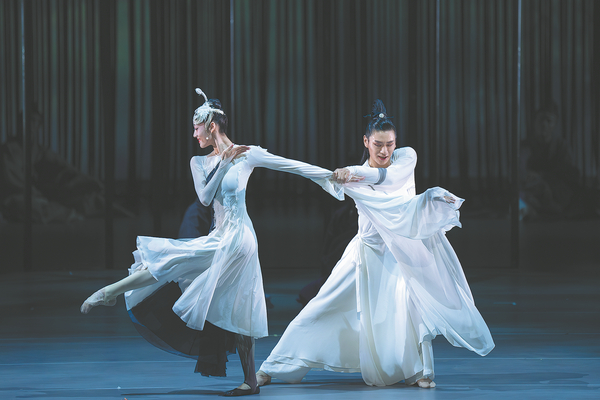
Yonghe Jiunian
Introduction
"Yonghe Jiunian" (Dance of Calligraphy in AD 353) is a contemporary dance drama produced by the Shanghai Opera House, which brings the timeless elegance of Chinese calligraphy to the stage. It premiered in November 2023 in Shanghai and quickly captivated audiences nationwide.
The performance draws inspiration from "Lantingji Xu", or Preface to the Collection of Poems of the Orchid Pavilion, a classic prose piece by the renowned 4th-century calligrapher Wang Xizhi. This cultural masterpiece was penned in AD 353 during the Eastern Jin Dynasty (AD 317-420) and has since been revered as a pinnacle of Chinese calligraphy.
Production
The dance drama is both directed and choreographed by Wang Yabin, who embarked on an artistic journey to bridge the ancient with the contemporary. Her vision was to convey the allure of Chinese calligraphy through the medium of dance, using the body as a brush to mimic the fluid, controlled movements of the ink strokes. The performance offers a fresh perspective on the origins and enduring legacy of Lantingji Xu, inviting audiences to transcend time and witness the beauty of this art form.
Set against evocative backdrops, such as lush bamboo forests and imperial courts, the story unfolds through the exploration of a young man who travels back to ancient China. Against this scenic canvas, the dynamic choreography seamlessly integrates the essence of calligraphy with the physical representation of the dancers, enhancing the visual storytelling and artistic impact of the piece.
Choreography
Under the creative direction of Wang Yabin, the choreography of Yonghe Jiunian vividly brings to life the essence of calligraphy. The dance movements are designed to reflect the elegance and fluidity of ink brush strokes, embodying a seamless blend of traditional and contemporary dance techniques. Wang Yabin, who also holds a deep admiration for calligraphy, has meticulously crafted each dance sequence to emulate the controlled motions and emotive expressions found in traditional Chinese handwriting.
The choreography incorporates elements from Chinese classical dance, including rhythmic twists, turns and curves. Dancers channel the strength and amplitude of calligraphy strokes, translating these qualities into physical movements that convey both force and grace.
Music and Costume
The musical composition of Yonghe Jiunian is an integral element that enhances the overall experience of the dance drama. Composer Lyu Liang utilizes the seven-stringed guqin, an ancient Chinese instrument, as the principal musical component throughout the performance. The guqin is complemented by an array of traditional Chinese instruments, such as the pipa, guzheng, xiao, xun and erhu. This rich orchestration creates a diverse palette of sounds that propels the plot and deepens the emotional resonance of the story.
The music is employed strategically to support the narrative structure, particularly in scenes that involve flashbacks. These musical cues guide the audience through the temporal shifts in the storyline, adding layers of depth to the unfolding narrative.
Costumes further enhance the visual storytelling of Yonghe Jiunian, with designs that evoke the historical context of the dance drama. The attention to detail in both music and costume design serves to transport the audience to the ancient world of the Eastern Jin Dynasty, enriching their experience of the narrative journey.
With its innovative blend of traditional themes and modern expression, Yonghe Jiunian stands as a testament to the enduring legacy of Chinese calligraphy and its ability to inspire contemporary art forms. Through the synergy of dance, music and visual storytelling, the performance captures the spirit of an ancient cultural masterpiece, inviting audiences to reflect on its historical significance and timeless beauty.








